Photocopy Machine Maintenance: A Practical Guide for Malaysian Offices
Good photocopy machine maintenance comes down to three layers: simple care your staff do every week, scheduled servicing by a trained technician, and a few things most offices forget until they cause trouble, namely paper storage in a humid climate, ventilation, the data on the machine’s hard drive and how the machine is disposed of at the end. Get those right and a copier will jam less, print cleaner and last longer, without surprises on the bill.
The machine’s job is changing rather than disappearing. As e-invoicing moves more invoices off paper (our e-invoicing guide for SMEs explains the rollout), the office copier spends more of its life on contracts, forms, signed documents and scanning, which makes reliability and data security matter more, not less.
What your staff can do every week
Most print-quality problems start with dirt, paper or careless handling, and none of these needs a technician. A short weekly routine covers most of it:
- Clean the glass. Wipe the platen glass and the narrow scanning strip used by the document feeder with a soft, lint-free cloth, following the manual. Streaks and lines on every copy often trace back to dust or correction fluid on the glass.
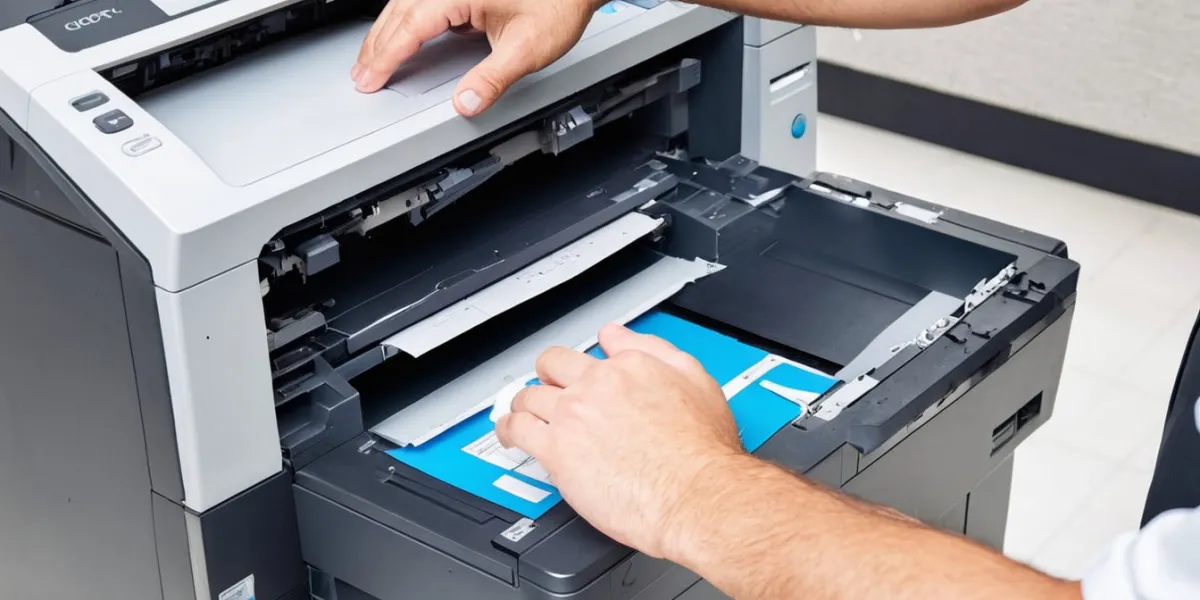
- Clear jams the way the machine tells you. Follow the on-screen steps and open only the panels it points to. Pulling paper out by force, or reaching in with scissors or a ruler, is how small jams become repair calls.
- Use the right consumables. Use the toner and parts your supplier specifies, and read what your service agreement says about third-party toner before you buy any.
- Respect the machine’s workload. Every model has a recommended monthly volume in its specifications. If your office routinely runs well past it, the problem is the machine’s size, not its maintenance.
- Keep a simple log. Note the date, the error code and what happened each time the machine stops. A technician who can see that the same jam recurs at the same tray will fix it faster.
Paper and the Malaysian climate
Paper absorbs moisture from the air, and paper that has gone limp or curled feeds badly. Lexmark’s printer guidance, for example, recommends storing paper at around 21°C and 40 per cent relative humidity, in cartons on a pallet or shelf rather than on the floor, on a flat surface and with nothing stacked on top, according to its paper storage guidelines.
Malaysia’s heat and humidity make that hard to match in an ordinary storeroom, especially where the air-conditioning goes off at night. The practical answer is to keep only a few days’ paper near the machine, keep the rest sealed in its cartons in the coolest, driest room you have, and load fresh reams rather than paper that has sat open in a tray over a long weekend.
Ventilation: the part of maintenance that is about people
Copiers affect the air around them. The Department of Occupational Safety and Health’s (DOSH) Industry Code of Practice on Indoor Air Quality 2010 names ozone emitted from photocopiers and laser printers among the common indoor air pollutants, and sets an acceptable limit for ozone of 0.05 ppm, according to the code.
You do not need instruments to act on that. Put busy machines in a ventilated area rather than a small closed room, keep them away from anyone’s desk, and ask your technician whether your model has an exhaust or ozone filter that should be replaced at service visits. If staff complain of stuffy air or headaches near the print area, treat it as an indoor air quality question rather than a nuisance.
What a professional service should cover
Inside the machine, rollers, the drum and the fuser wear with use and need inspection and eventual replacement, which is the technician’s job, not the office manager’s. A service visit should include cleaning the paper path, checking those wear parts against the manufacturer’s schedule, updating firmware and testing print quality on every tray.
The alternative to one-off repair calls is a service contract. Rental plans from copier machine suppliers in Malaysia such as Optimus Business Solutions include maintenance and after-sales support in the rental, which moves most of the maintenance burden to the supplier. Before you sign any contract, check four things:
- What the fee covers: parts, labour, toner, or only some of them.
- How quickly a technician will respond, and whether a replacement machine is provided if a repair takes days.
- What happens to the machine, and its hard drive, at the end of the term.
- Whether service tax is charged, and at what rate.
That last point changed in 2025 for rentals. Rental and leasing services became subject to service tax at 8 per cent from 1 July 2025, with the rate set at 6 per cent from 1 January 2026, according to a BDO summary of the Royal Malaysian Customs Department’s guide. Whether a given rental is taxable depends on the supplier’s registration and the guide’s conditions, so check with the supplier or a tax adviser rather than assuming.
The hard drive nobody remembers
A modern multifunction copier is a networked computer with a printer attached. The US Federal Trade Commission’s guide to digital copier data security warns that a copier’s hard drive stores data about the documents it copies, prints, scans, faxes or emails, and that the data can be stolen remotely or once the drive is removed.
For a Malaysian business, those documents often include customers’ and employees’ personal data, which Malaysia’s personal data protection law expects you to keep secure. The FTC’s advice translates directly: make sure your lease says you keep the drive at the end of the term or that the supplier overwrites it, and let a skilled technician handle the drive rather than removing it yourself. Ask for written confirmation when the machine leaves your premises.
Treat the copier as part of your IT estate as well: change the default administrator password, keep its firmware updated at service visits, and switch off network features you do not use.
Disposal: old machines and toner
When a copier reaches the end of its life, it becomes electronic waste. Malaysia classifies e-waste as scheduled waste under code SW110 of the Environmental Quality (Scheduled Wastes) Regulations 2005, and industrial generators are expected to report and dispose of it properly through the Department of Environment’s eSWIS system, Malay Mail explained.
Licensed recovery facilities do exist: Malaysia had 23 full e-waste recovery licensed facilities and 110 partial ones nationwide, The Star reported in March 2026, as the environment ministry worked on an extended producer responsibility framework. The simplest route for most offices is to ask the supplier to take back old machines and used toner cartridges, and to keep a record of where they went.
A maintenance checklist for the office
- Weekly: clean the glass, check paper stock and storage, note any error codes.
- At every service visit: wear parts checked, firmware updated, filters replaced where fitted, print quality tested on every tray.
- Every year: compare actual monthly volume with the machine’s rating, review the contract and its service tax line, and confirm the admin password has been changed.
- At the end of the term: hard drive overwritten or returned to you, machine and toner taken back by a licensed route, paperwork kept.
The same logic applies beyond the copier. Our look at the hidden costs of air conditioning maintenance in Malaysia makes the same case for the other machine every Malaysian office depends on.