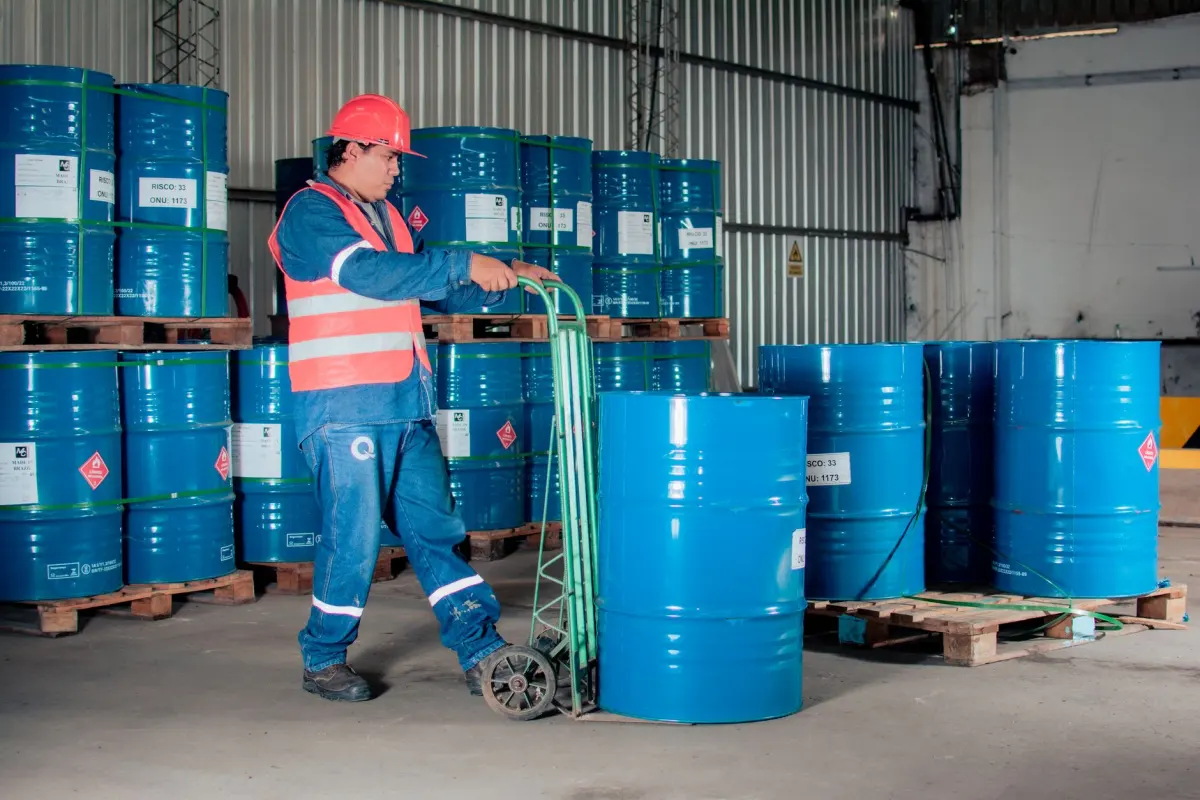
Spill kits for Malaysian factories and workshops: what to stock and where
A spill kit only earns its place on a factory floor if it matches the liquids you actually use, sits where spills actually happen, and is handled by people who have practised with it. For most Malaysian factories and workshops, getting there means three habits: read each chemical’s safety data sheet before buying absorbents, keep the kit next to the risk rather than in a store room, and treat anything used to clean up oil or chemicals as scheduled waste.
None of this needs a big budget. It does need someone to own it, because a kit that was bought once and never checked tends to be missing half its contents on the day it is needed.
Start with the safety data sheet, not the catalogue
A safety data sheet (SDS) prepared to Malaysian requirements follows a fixed order of headings, and Section 6 is “Accidental release measures”, according to the Industry Code of Practice on Chemicals Classification and Hazard Communication issued by the Department of Occupational Safety and Health (DOSH). That section covers personal protective equipment and emergency procedures, environmental precautions, and the methods and materials for containment and cleaning.
The same code asks the supplier to distinguish between small and large spills where the volume changes the hazard or the response. In other words, the answer to “what should be in our kit?” is already in your SDS folder.
A practical first step is to list every liquid kept on site in drums, jerry cans or IBCs: cutting and hydraulic oils, fuels, solvents, acids, alkalis and cleaning chemicals. Next to each one, note what its Section 6 says about absorbents, ignition sources, ventilation and drains. That short table becomes the specification for your kit.
Match the absorbent to the liquid
Sorbents come as loose granules, sheets or rolls, pillows and booms, and there are different types for different liquids, such as oil-selective and chemically resistant sorbents, notes GPP 22, the UK pollution prevention guidance on dealing with spills. It advises checking with your supplier which sorbents suit the substances you store.
On a typical Malaysian shop floor that comes down to three families:
- Oil-only sorbents for lubricants, hydraulic oil and diesel, useful on a wet loading bay because they are made to take up oil rather than water.
- Universal or general-purpose sorbents for mixed workshops where coolant, water-based cleaners and oils all end up on the same floor.
- Chemical sorbents for acids, alkalis and aggressive solvents that would break down an ordinary pad.
The format matters as much as the type. Pads suit flat floors and drips under machines, socks and booms ring a spill to stop it spreading, pillows take a larger volume in one place, and granules work on rough or uneven concrete where a pad will not sit flat.
When you buy spill kits and absorbents, look for a supplier that sells pads, socks and pillows individually as well as in ready-made kits. That allows one complete kit per risk area, topped up from loose stock after each use, instead of a new kit every time.
Check the personal protective equipment as well. If Section 6 of an SDS calls for chemical-resistant gloves or eye protection, those belong inside the kit, not in a locker on the other side of the building.
Put the kit where the spill will happen
Pollution control equipment should be placed near where it may be needed, easily accessible but protected from damage and unauthorised use, and staff should be trained to use it safely with suitable protective equipment, according to GPP 22. The same guidance gives drain mats kept close to manhole covers and open gullies as an example.
In a Malaysian factory, the usual places are the drum store, the chemical decanting point, forklift charging and maintenance bays, the loading dock and any machine with a hydraulic system. Walk the route from each of these to the nearest open drain. If a leak would reach that drain before someone could fetch a kit, the kit is in the wrong place.
Drains deserve particular attention. The DOSH code lists keeping a spill away from drains, surface water and ground water as an example of the environmental precautions an SDS should give, and it names bunding and covering drains among containment techniques. A drain cover or mat in the kit is often the single most useful item in it.
What the law expects of the employer
The Occupational Safety and Health (Amendment) Act 2022 came into force on 1 June 2024 and extended the Act to all places of work in Malaysia, as law firm Lee Hishammuddin Allen & Gledhill summarised in April 2024. It added duties to carry out a risk assessment and to develop and implement procedures for emergencies that may arise in the course of employees’ work.
A chemical or oil spill is exactly the kind of emergency those procedures should cover. The same summary notes that maximum fines for employers convicted of certain offences rose ten-fold, from RM50,000 to RM500,000.
Waste rules apply too. The Environmental Quality (Scheduled Wastes) Regulations 2005 require scheduled wastes to be kept in compatible, durable containers that prevent spillage or leakage, with incompatible wastes in separate containers placed in separate secondary containment areas. Regulation 15 requires every waste generator to make sure employees involved in the handling, storage and spillage or discharge response of scheduled wastes attend training programmes.
This is a summary, not legal advice. The Department of Occupational Safety and Health, the Department of Environment and a registered safety and health officer are the right places to confirm what applies to a particular site.
After the spill, the absorbent becomes scheduled waste
A pad used on oil or chemicals does not go into the general bin. The First Schedule of the Scheduled Wastes Regulations lists SW 410 for rags, plastics, papers or filters contaminated with scheduled wastes, and SW 408 for contaminated soil, debris or matter from cleaning up a spill of chemical, mineral oil or scheduled wastes.
In practice, used sorbents go into a closed, labelled container in the scheduled waste store, are recorded in the site’s waste inventory and leave with a licensed contractor. The regulations allow a waste generator to store its scheduled wastes for 180 days or less, provided no more than 20 metric tonnes accumulate on site.
That has a cost side worth knowing. Every pad used on a spill that a drip tray could have prevented is a pad you pay for twice: once to buy and again to dispose of. GPP 22 makes a similar point, that sorbents generate waste and are best used on small spills or on spills that have already been contained.
Keep the kit ready
A spill kit is a piece of equipment, so it needs an owner and a routine. A short checklist covers most of it:
- Replace everything used, on the same day, from loose stock.
- Check each kit monthly: seal intact, contents complete, gloves and goggles within their shelf life.
- Keep the matching SDS pages and the site’s emergency procedure with the kit or beside it.
- Run a short drill with each shift so that the first time someone opens the kit is not during a real spill.
- Record each spill and what it took to clean up, because a pattern of small leaks points to a container or machine that needs repair.
The drill is the part most often skipped and the one that makes the rest work. A worker who has once ringed a mock spill with a sock, covered a drain and bagged the waste will do it calmly when it matters.
The test of a good set-up is simple: pick any drum on site, imagine it leaking, and time how long it takes to have the right absorbent, the right gloves and a drain cover in place. If the answer is under a minute, the kit is doing its job.