Why printed name cards still matter in Malaysia-Singapore B2B
Printed name cards still matter in Malaysia-Singapore B2B meetings because they do a job a phone does badly: they hand over your name, title and company in a second, in a form the other side can keep and act on later. On both sides of the Causeway, business card networking still earns its place at first meetings, supplier visits and trade fairs. Getting the card right, and handing it over well, costs little.
The Singapore relationship is too big to treat casually
Singapore is one of Malaysia’s largest export markets. Malaysian exports to Singapore reached RM249.55 billion in 2025, ahead of exports to the United States or China, according to the Ministry of Investment, Trade and Industry (MITI).
Behind those figures are people meeting in person: a buyer visiting a factory in Johor, or a distributor walking a trade fair floor. When the two governments exchanged the Johor-Singapore Special Economic Zone agreement on 7 January 2025, one stated aim was “enabling freer movement of people”, according to a factsheet from Singapore’s Ministry of Trade and Industry, published by the Economic Development Board.
Our guide to exporting from Malaysia covers MATRADE support and the paperwork. This piece deals with the smaller object that usually comes first: the card you hand over when you meet.
Why paper still beats a phone at the first meeting
A digital profile is useful, but a first meeting is rarely the place to pull out a phone, open a scanner and wait for a page to load. At a busy booth, or with five people around a table, a card passes across in a second and reads at a glance. It also stays on the buyer’s desk after you leave, ready when they compare suppliers.
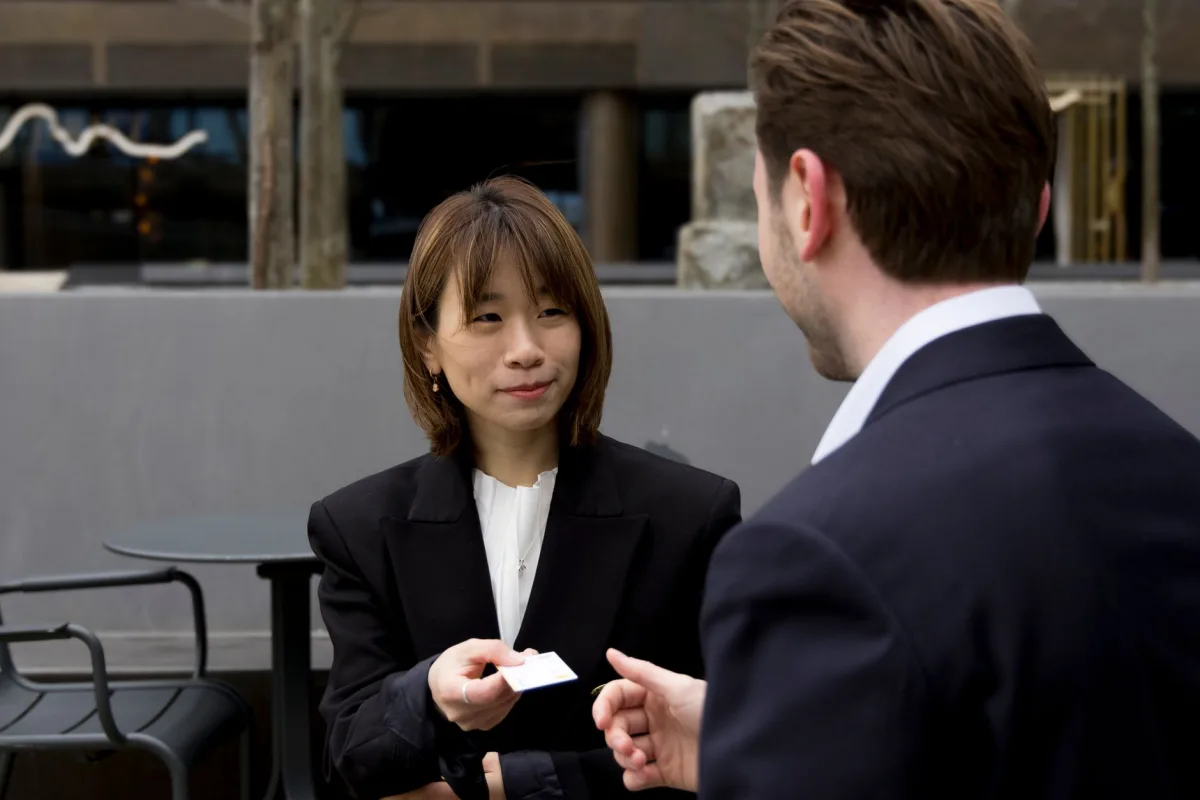
In Singapore the exchange itself carries meaning. Business cards are exchanged right after introductions and presented with both hands, notes a Singapore business etiquette guide published by Innovation Norway.
What a good Malaysia-Singapore name card carries
Contact details that work in both countries
Write every phone number in full international format, with the country code, so a Singapore contact can save it or tap it without guessing. If you have a Singapore number, a Singapore address or a WhatsApp line for enquiries from across the Causeway, put it on the card, because a local number removes one small reason not to call.
Bilingual details, chosen deliberately
If you print a second language, keep English on the front and the second language on the reverse, so the card works for every reader. Choose the language your buyers actually read, and have that side checked by a native speaker, because a wrong character is printed on every card in the box. Spell your name the way you want to be addressed, and make the family name clear if the order could confuse a reader.
A QR code that leads somewhere useful
A QR code links the printed card to your digital profile, as long as it points to a page you control: a company profile, a product catalogue or a WhatsApp Business chat. Scanning is routine on this route, and Singapore’s land checkpoints with Malaysia have offered passport-free QR code clearance since March 2024, according to the same factsheet. Test the code on more than one phone before printing, and avoid a link shortener you might stop paying for.
If the code opens a WhatsApp chat, set up the catalogue and greeting message first; our WhatsApp Business guide for Malaysian SMEs covers the settings worth using.
Stock, finish and room to write
Matt stock is usually easier to write on than gloss, which matters at a trade fair, where the person you met may want to jot “send samples” on the back once you have moved on. If you print both sides, leave some white space; a card crammed edge to edge with services reads like a flyer.
Quantities and lead times before a Singapore trip
Work out quantities from the event, not from the minimum order. Forty useful conversations a day at a three-day fair, say, is already 120 cards, before you add dinners, meetings and the colleague who forgot to pack theirs.
Lead time is the part that catches people out. Order early enough to see a proof, correct it and still keep a buffer, especially when a new hire, a new title or a Singapore address has to go on the card.
If your team is flying in for a fair or a round of buyer meetings, name card printing in Singapore is worth weighing against your usual Malaysian printer, because the cards can be collected close to where you will hand them out. Kiasu Print’s name card page, for example, lists digital cards at three to four working days after artwork confirmation and offset matt-laminated cards at five to seven working days. It prints cards at 90 x 54 mm and offers self-collection in Singapore.
Etiquette that works on both sides of the Causeway
- Offer it facing them. Hold the card with both hands, text turned towards the receiver, and say your name as you hand it over.
- Read the card you receive. Take a few seconds over the name and title before putting it away; it is also the moment to ask how to pronounce a name you are unsure of.
- Keep it on the table during the meeting. In a group, laying the cards out in seating order helps you use the right names.
- Use a card holder. It keeps your cards clean and gives the ones you receive a better home than a back pocket.
- Write notes later, not in front of them. Save the “met at booth, wants a quote” note for after the conversation.
What happens to the cards after the event
A stack of cards is only worth something if you follow up while the conversation is fresh. Sort them the same evening into buyers, partners and “maybe later”, then send each a short message that names where you met and what you promised.
Singapore’s data protection rules make room for this kind of contact. The Personal Data Protection Commission (PDPC) says the PDPA’s data protection provisions do not apply to business contact information, and is likely to treat name card details that way in most circumstances, according to its advisory guidelines on key concepts in the PDPA. In its own example, a seminar guest drops her name card into a glass bowl at the registration booth, and the organiser may contact her about future seminars without seeking her consent.
The exemption depends on purpose: the same guidelines say a card handed over solely for personal reasons, such as a gym membership, is ordinary personal data.
Malaysia has its own Personal Data Protection Act, whose amendments brought in a duty to notify the Commissioner of data breaches and, above set thresholds, to appoint a data protection officer, both from 1 June 2025, as a Nishimura & Asahi briefing sets out. Before loading a fair’s worth of cards into a CRM or mailing list, check the rules with the Commissioner or a lawyer rather than assuming Singapore’s approach applies at home.
Before your next Singapore meeting
- Scan the QR code on two different phones.
- Order with enough time to see and approve a proof.
- Pack more cards than you expect to need, in a holder you can reach quickly.
- Block an hour after the event to sort the cards and send follow-ups.
When a conversation turns into an order, the next question is how an overseas buyer pays you. Our guide to cross-border payments for Malaysian SMEs sets out the options.